Mastery has two axes, and AI took one
A national coffee champion scoffed at my precision obsession and pulled a better shot than mine without looking. It took me years, a career change, and the arrival of AI to understand what he had, and which half of skill is still worth training.
I remember the first time I drank a good cup of coffee. Thing is, I wasn't a coffee drinker. That strong, sour energy potion? Just not for me.
Then I moved to Montreal and drank my usual hot chocolate. Apparently, coffee at this place was good. So why not try a mochaccino? Well, that was good. Let's try a latte next. Then a cappuccino. And finally that day came, where they just offered me an espresso. "Taste this, and your life will change."
And oh yes, it did. It hit just right. No sourness to be found. A slight acidity. Definitely a strong taste, packed with flavor. That day is when I discovered specialty coffee, and my life, indeed, did change.
That raised the question: how do you get there?
I started exploring, asking questions, watching YouTube videos (mostly James Hoffmann). And I realized coffee is so much more than a black drink for energy. It's an industry, a worldwide system. And precision at an insane level. When you explore the highest level of coffee making, you realize everything has to be controlled, from sourcing the green beans to the mineral levels in the water you're using. The way you pour, the way you grind, the way you roast, the way… you get it. It's a crazy world.
You get sucked into it. You think coffee, you sleep coffee, you live coffee. It consumes you. Every time you prepare one, it becomes a ritual, automated steps into making that perfect pour. You want to get the same feeling again, of that perfect shot.
That's craft.
And then, you start to realize that some of the best coffee you've tried in coffee shops doesn't have that level of precision. They don't control every little thing the way you can at home. They need to balance precision and speed, and they do it incredibly well.
And you start talking with them. I remember vividly discussing this topic with Clément, owner of Kohi, a coffee shop my hometown has since lost. He went to the Aeropress World Championship after winning the national one. He's one of the most knowledgeable people I know when it comes to coffee. And I was talking about how precise and specific everything has to be, how I'm struggling with this and cannot reproduce it.
He basically scoffed it off and told me that, in the end, coffee doesn't have to be that serious. Just try things, and things work. And he's pulled some of the best shots I've drunk.
In the end, it's not just about pure craft. There is something else. That capacity to just wing things and yet make them almost perfect, on repeat, while not being consistent and not controlling every input.
That's guts. That is beyond craft.
What Clément was actually saying
For a long time, I heard that conversation wrong.
What I heard was: precision doesn't matter. Relax. Stop weighing your water. And honestly, that reading annoyed me, because precision was the only tool I had. I couldn't wing a shot. When I tried to "just try things," I got sour, bitter, thin disappointment. His advice seemed to work for him and fail for me, which is the most frustrating kind of advice.
It took me years to understand that he wasn't dismissing precision. He was standing on top of it.
Clément has pulled thousands of shots. He has dialed in more grinders, tasted more roasts, and corrected more mistakes than I will in my lifetime. He competed at a national level, which means at some point he obsessed over variables I don't even know exist. All of that is in his hands now. When he "wings it," his hands are running on a dataset I don't have. He doesn't need to measure, because he has already measured more than I ever will. The measuring moved inside.
That's what guts is. Not the absence of craft. Craft, metabolized.
And this is the part that matters if you, like me, are the precision type: you cannot skip to guts. Instinct without the floor of craft is just confidence, and confidence without a floor has a name: gambling. But you can also get stuck on the craft side forever, polishing scaffolding long after the building could stand. I was stuck there. In coffee, and not only in coffee.
The plan is not the race
Coffee is the small version of this story, the harmless one.
I'm training for an Ironman in 2027. Triathlon is the most craft-saturated hobby I have ever touched, and that is saying something coming from a specialty coffee person. Everything is measured. The plan tells me what to do on Tuesday: which intervals, which zones, how long, how hard. Power on the bike, pace on the run, stroke count in the pool if you want to go down that road. The entire sport is an invitation to believe that fitness is a spreadsheet, and that race day is the sum of the cells.
I love that part. Of course I love that part. It's the same pleasure as the coffee ritual: controlled inputs, repeatable steps, a number that tells you that you did the thing. In winter, the sport reduces entirely to this. You sit on a trainer in a quiet room, the workout loads, and you produce the prescribed effort while a graph fills in. No race in sight, no feel to consult, months of files. The winter arc gets dark, and the darkness is the price of the floor: craft is the only axis you can train alone in a quiet room in January.
But every long ride teaches the other lesson. The plan says hold this effort, and somewhere far from home, the day disagrees. The wind picks up. The heat sits on you. Your legs report numbers that have nothing to do with the file you uploaded. And now you're doing the actual sport, which is not executing a plan. It's negotiating with fatigue, with conditions, with your own head, using a feel you can only have built by being out there long enough, including the days you got it wrong. I have followed the plan too literally and paid for it late in a session. The plan was right on average. The day was not average. Days never are.
Endurance athletes have a phrase for the goal state: racing by feel. Who earns it is the point. Racing by feel at the sharp end of a race is Clément pulling a shot without a scale: metabolized craft. The measured intervals didn't disappear. They became the calibration of the feel.
Same two axes. The plan is craft. The negotiation is guts. The plan builds the floor, the long days build the feel, and the race is run on both.
Wrongness has a smell
I came to engineering through the side door, carrying a decade of adjacent fields with me: SEO, analytics, UX, a lot of marketing, some business. The textbook version of my situation says I should have spent years building an engineer's instincts from zero, the way I built coffee instincts: slowly, shot by shot. That's not what happened. And the reason it's not what happened turned out to be the most useful thing I know about guts.
It started with a feeling I recognized. Ten years into SEO, after enough companies and enough broken websites, I could open a site and feel what was wrong with it before any tool finished crawling. Not name it, feel it. The audit that followed was for everyone else: the document, the evidence, the prioritized list. The craft artifact. But the diagnosis had already happened in the first minutes, produced by some pattern-matching layer that a decade of broken websites had trained without asking my permission. At the time I thought that was SEO expertise. I now think it was guts, sitting on ten years of craft.
Here's the discovery: that layer came with me. Not the SEO knowledge itself. The pattern-matcher. Engineering turned out to be full of textures I had already learned to read elsewhere: the analytics instinct for numbers that are technically correct and practically misleading, the UX instinct for flows that demo well and fail in real hands, the marketing instinct for claims that are slightly too clean. Once one field has taught you what subtly-off feels like, you calibrate faster in the next one. The verdicts of guts stay local (my feel for websites says nothing about embedded firmware, and pretending otherwise is the gambling kind of confidence). It took Kahneman and Klein a six-year adversarial collaboration to agree on when intuition can be trusted, and they landed on two conditions: a regular environment, and prolonged exposure with honest feedback1. That's the local part. But the capacity to grow guts compounds across fields. Cross-pollination isn't a line on a CV. It's an accelerator on the axis you can't schedule.
And now the confession that will sound like heresy to half the engineers reading this: I don't really read code anymore. I barely write it. AI does that for me, and I embraced that early and completely. My instinct never lived at the semicolon level anyway. It lives where it lived in SEO: in the smell of an answer. When an AI proposes a design, defends a choice, or pushes back on mine, there's a moment where something feels off before I can say why. A solution slightly too pleased with itself. A pushback that defends the wrong thing. A plan whose confidence doesn't match the territory. I catch those the way I used to catch broken websites: pattern first, argument second. Producing the argument is still craft, and I still have to do it. But the detection is guts, and it transferred.
The machines took the easy half
I build AI features for marketers at Adobe, and like every engineer right now, I work next to tools that generate code. What the current generation of AI is good at, strikingly good at, is the craft half. The controlled, specified, repeatable part: the boilerplate, the migration, the test scaffold, the correct-shaped function from a clear description.
What it cannot give you is the other axis. The feel for whether the generated thing is right. Whether the answer smells off. Whether this is even the thing worth building. Reviewing AI output is, almost by definition, a guts exercise: the precision came from the machine, so your contribution is the calibrated instinct that says yes, no, or wait. And that instinct still has the same price tag it always had. Exposure, volume, mistakes you were present for.
I find that clarifying. Where problems are well specified, AI supplies craft and the human value concentrates on the guts axis; where the territory is vague or new, you still need both, the old way. But the direction of travel seems clear enough to act on. Polanyi had a name for this split sixty years ago, tacit knowledge: "we can know more than we can tell"2. The half of mastery the machines absorbed first is the half we could tell. The half that's left is the one you can only metabolize.
There's a question buried in that, and I don't have a clean answer to it. If guts is metabolized craft, and the machines now do the craft, where does the next generation's exposure come from? I built my nose for broken websites by auditing them by hand for a decade. The tedium was the tuition. An engineer who starts today can generate in seconds what I had to assemble slowly, which is a gift for output and possibly a tax on calibration. Part of my own answer was imported: I arrived carrying a pattern-matcher trained in other fields. Maybe that's the general shape. When machines take the repetition in your field, the exposure has to come from somewhere else: another field you've actually walked, or a thousand judged answers instead of a thousand written ones. Maybe. I notice the people most confident about that answer tend to be the ones selling the tools.
Two axes, not a tradeoff
So here's the pattern I now can't unsee, the one this whole essay has been circling.
Craft and guts are not two ends of one slider. They're two axes, and you can be anywhere on the plane. The precision-only corner is where I lived: rituals, scales, checklists, and a quiet panic whenever conditions changed, because adaptation was never in the procedure. That corner plateaus. The instinct-only corner fails the other way: all feel, no floor, brilliant once and unable to repeat it. That corner ceilings out early.
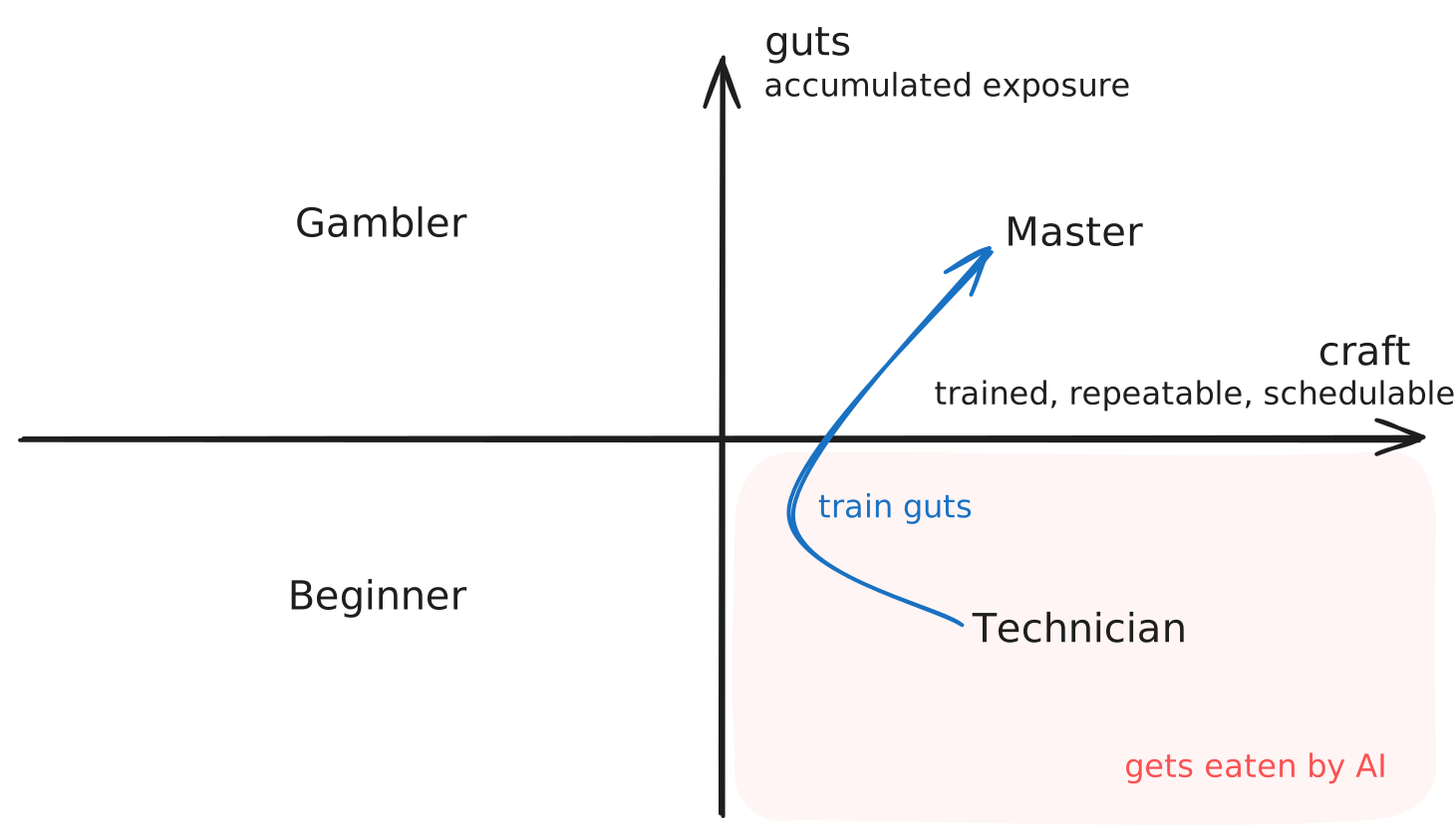
The ones I admire, in any domain, are high on both. Clément, who measured for years so he could stop measuring. The athletes who execute the plan all winter so they can throw it away on race day. The engineers whose "this feels wrong" is right often enough that you stop asking for the argument first. In every case the order is the same: craft first, accumulated until it turns into feel, then instinct trusted only inside the territory that built it.
The two axes even train differently. Craft responds to deliberateness: study, repetition, correction. Guts responds to exposure: volume, variety, and honest contact with your own failures. You can schedule craft. You can only invite guts.
And once you see the plane, you start noticing where people have parked themselves on it. Here's the uncomfortable observation, and I include myself in it: watch what someone defends as "their style." The precision person says style is rigor, and hasn't trusted their gut in years. The instinct person says style is flow, and hasn't deliberately trained a weakness in years. Style is very often the name we give to the axis we stopped training.
I don't fully know what the balance looks like yet. I'm still mostly a craft person learning to let accumulated exposure actually count for something, in coffee, in training, in code. Some days I manage to wing the shot. It's usually not as good as Clément's.
But I keep thinking about which axis I'm avoiding, and I'd ask you the same question. What are you calling your style?
References
[1] Daniel Kahneman and Gary Klein, "Conditions for Intuitive Expertise: A Failure to Disagree," American Psychologist 64, no. 6 (2009): 515-526. doi.org/10.1037/a0016755 ↑
[2] Michael Polanyi, The Tacit Dimension (Doubleday, 1966). The Tacit Dimension ↑